 |
OXFORDSHIRE FOLK DANCE ASSOCIATION |
|
Harry Fell
1935 - 2024
Harry Fell was born at 7 Kiln Lane, Headington – A house originally numbered 5 – where his roots in the community were firmly set from the very beginning. As far as is known, Kiln Lane remained his home throughout his childhood and youth, until he left Headington in the late 1950sto attend teacher college in York. It was there that he met Gillian, his wife to be for many years, a partnership that would remain central to his life following their marriage, Harry and Gillian settled in the village of Ewelme in Oxfordshire, where they made their home and remained for the rest of their lives. That enduring connection to place, people and tradition would come to define both Harry’s character and his involvement in Oxfordshire folk life.
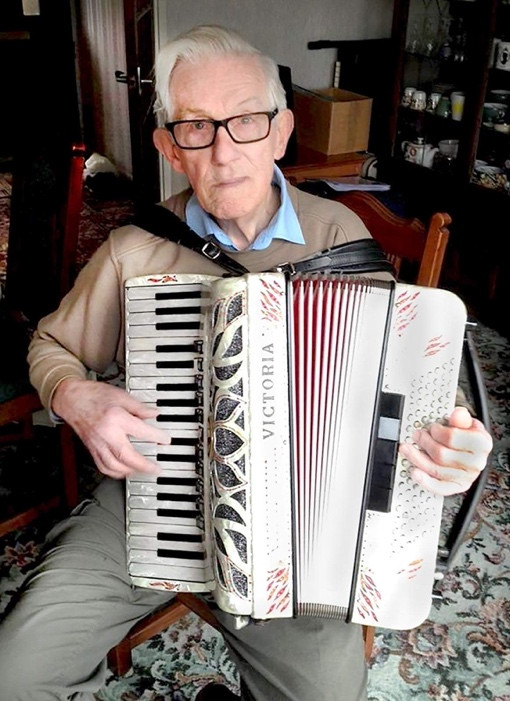
Harry had no formal musical training, yet he became a very accomplished accordionist. Entirely self-taught, he could read and understand written music with ease, a testament to his natural aptitude and quiet determination. Any early encouragement he received would have been informal, likely emerging from the rich musical culture of Headington Quarry itself.
He was a familiar and valued presence in the local folk world. Harry danced for the Sunday Club, an involvement remembered with particular clarity, though it was John Graham—not Harry—who played the accordion for those occasions. He was also a committed member of the Headington Quarry Morris Dancers, contributing steadily to a tradition that mattered deeply to him.
While Harry would not have described himself as a band leader, he was actively involved in a number of local folk groups over the years. Names such as The Friendly Folk and Bodgers Wood are remembered, and he is thought to have played the accordion with some of these ensembles. As with much folk history, details soften over time, but what remains clear is that Harry valued participation over prominence and the shared enjoyment of music above all else.
True to his beliefs, Harry was adamant that “folk” meant traditional. He was sceptical of modern composition within the genre, though he may well have taken older, informal versions of tunes and carefully worked them into forms suitable for contemporary listening—quietly bridging past and present without ever claiming authorship.
Beyond music and dance, Harry had a range of interests. He participated in handbell ringing, with at least one photograph of him appearing in the Oxford Mail in the late 1950s. He was a keen collector, particularly of Meccano, beginning with set number 2 and eventually amassing a number 10 set and many additional parts. He also collected coins, stamps, cigarette cards, and records, including early 78s such as Albert and the Lion.
Harry enjoyed logic puzzles, happily tackling Sudoku and helping others with crossword clues when needed. Though not much of a traveller, he made memorable visits to the Scottish Highlands in his younger years and later enjoyed family camping holidays in the Yorkshire Dales. These quieter pleasures were shared with Gillian and their two children, David and Caroline, and formed the steady family life that was rooted in Ewelme.
Harry Fell’s legacy lies not in grand gestures or formal recognition, but in steady, generous participation: a quiet custodian of tradition, a skilled and thoughtful musician, and a man deeply rooted in his community. He is warmly remembered as part of the living fabric of Oxfordshire folk life.
Chris & Alan Kimber-Nickelson